
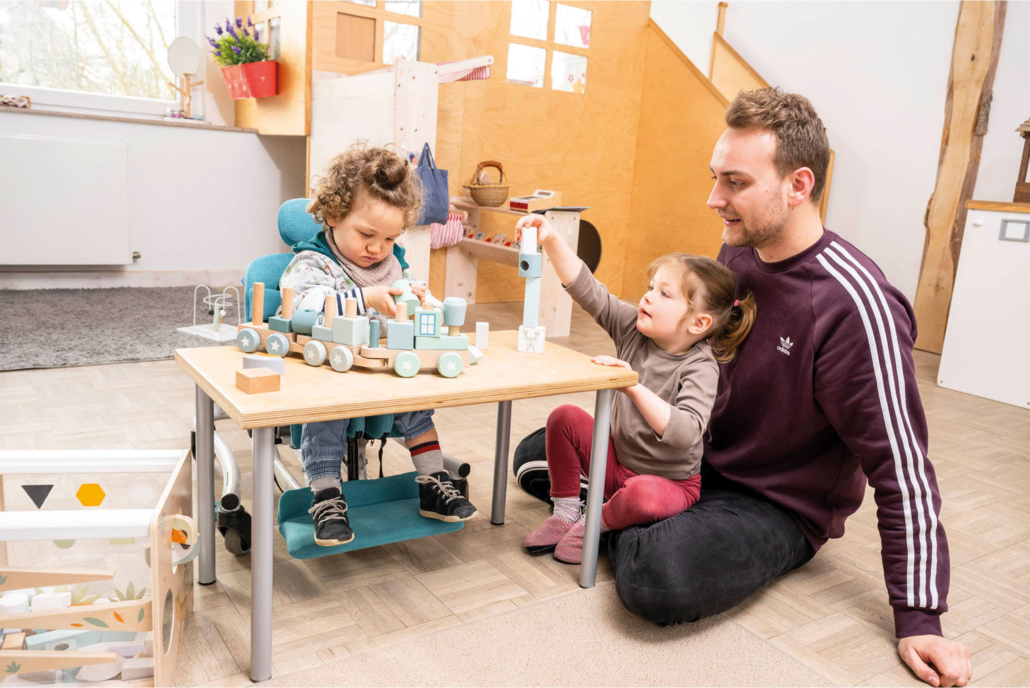
The Best Possible Seating in the Right Therapy Chair
1. Positive Effects of Proper Sitting
Sitting is a basic human posture that becomes even more crucial for people with disabilities. Correct sitting posture is essential to prevent deformities. Even for the youngest children, attention should be given to ensuring that the spine, pelvis, and hips are protected from damage caused by poor posture.
The right seating aid, which can be individually adjusted, not only prevents incorrect posture but also makes sitting as comfortable as possible. In fact, the best possible sitting position positively affects not just back health but also digestion and breathing. Additionally, it helps reduce fatigue, and most importantly, it allows children and young people to participate in everyday activities, play with friends, or engage in other pursuits. This also helps ease the burden on parents and teachers.
Discovering the World While Sitting
Each seating aid offers the necessary support and ensures the hands remain free for play. With a removable backrest, the greatest possible freedom of movement can be achieved. This freedom in the upper back area motivates children to stand up and stay active. However, children should not remain in the same position for extended periods. Our seating aids are designed to offer various position changes. For example, the seat can be tilted forward or backward. Some aids also encourage active sitting, where the backrest moves with the child’s motion, which can help reduce both physical and mental tension.
We believe it’s important that all seating aids are tailored to the needs of children, parents, and therapists. This means they can be used in versatile ways, are easy to handle, and offer a wide range of functions to ensure children feel comfortable—not only while sitting but also when lying down. For children who suffer from severe contractions and pressure sensitivity, we offer a lying system. In this mobile system, children can feel relaxed, and it allows for a temporary sitting position when needed.
2. Which Therapy Chair is Right for My Child?
There is a wide range of therapy chairs available for children and young people with disabilities. Sorting through them and finding the right one can be overwhelming. We’ve compared our seating aids to give you a quick overview. However, this is no substitute for expert advice from a specialist retailer or professionals in the therapeutic or medical fields.
3. GMFCS Levels and ICF Codes
The GMFCS (Gross Motor Function Classification System) level indicated for our aids provides a general idea of their suitability for children or young people with disabilities. GMFCS is a simplified classification of gross motor skills in children and youth. This classification is listed on each of our products. You can find a more detailed explanation of the individual GMFCS levels in our catalogue on page 10.
The ICF (International Classification of Functioning) codes below give information on classifying health components based on the bio-psycho-social model. This model considers components such as “body functions,” “body structures,” “activities and participation,” and “environmental factors,” highlighting their interactions. For reference, we list the most relevant codes for our products below:
Body Structures/Functions:
- s710 – Structure of the head and neck
- s720 – Structure of the shoulder region
- s730 – Structure of the upper extremities
- s740 – Structure of the pelvic region
- s750 – Structure of the lower extremities
- s760 – Structure of the trunk
- b730 – Muscle strength functions
Activities/Participation:
- d160 – Focusing
- d415 – Maintaining body position
- d550 – Eating
- d560 – Drinking
- d710 – Basic interpersonal communication
- d750 – Informal social relationships
- d815 – Preschool education
- d820 – School education
- d880 – Playing
- d910 – Community life
4. The Different Therapy Chairs
Small Support, Big Impact
Therapy chairs like our smilla. (GMFCS levels 1-3) are praised for their aesthetic design and nearly invisible support. These aids are designed for children and young people who require minimal support. Children should be able to control their head independently and maintain basic posture to sit comfortably in this chair. Optional leg guides, thoracic supports, or belts can be added if needed. smilla. is easily adjustable in height, seat angle, and depth, ensuring that even with minimal support, the needs of children and youth are met optimally (ICF code: s710-s760). Quick adjustments using knobs or buttons make it easy to adapt to different situations, such as those encountered in nursery environments (ICF code: d815, d880, d750).
Find out more about our smilla.
Therapy Chairs for Every Occasion
Therapy chairs from our madita.-family (GMFCS levels 3-5) offer more support. The ergonomically shaped seat ensures proper pelvic positioning, and thigh guides or an abduction wedge can promote healthy pelvic development. A dysplasia seat is also available as an option to support hip joint development (ICF code: s740). The backrest can be removed for more activity or kept in place for additional support, with optional upper arm guides (ICF code: d415). The height- and angle-adjustable footrest ensures proper foot positioning (ICF code: s750). If needed, a foot strap can help improve foot positioning gently. For those with limited head control, various headrests offer additional support.
More Play, More Fun
For children who need a therapy chair that allows for more active sitting and play, the madita-fun. is ideal. Its underframe can be lowered to floor level, enabling children to play at eye level or transfer independently. It also allows them to eat comfortably at table height (ICF codes: d710, d910, d550, d560).
Find out more about our madita-fun.
Optimal Support for the Youngest Children
madita-fun mini. offers support for very young children. It combines the features of madita-fun. but is adapted to the needs of children weighing up to 20 kg. It can be lowered to the floor, allowing children to play at eye level (ICF code: d710, d910). Features like the anatomical or dysplasia seat ensure the proper development of the hip joints. Proper positioning in a suitable therapy chair is especially important in early childhood to prevent long-term issues.
Find out more about madita-fun mini.
A Place of Calm for Energetic Children and Adolescents
Our madita hd. therapy chair is built for higher weight loads. Its reinforced frame provides safety for children and adolescents with high energy levels. The chair is well-padded for comfort, and its height and seat angle can be adjusted to offer greater sitting flexibility. While more active models move with the child, the reinforced madita hd. provides stability and security for children and teens who are more restless (ICF code: b760).
Find out more about madita hd.