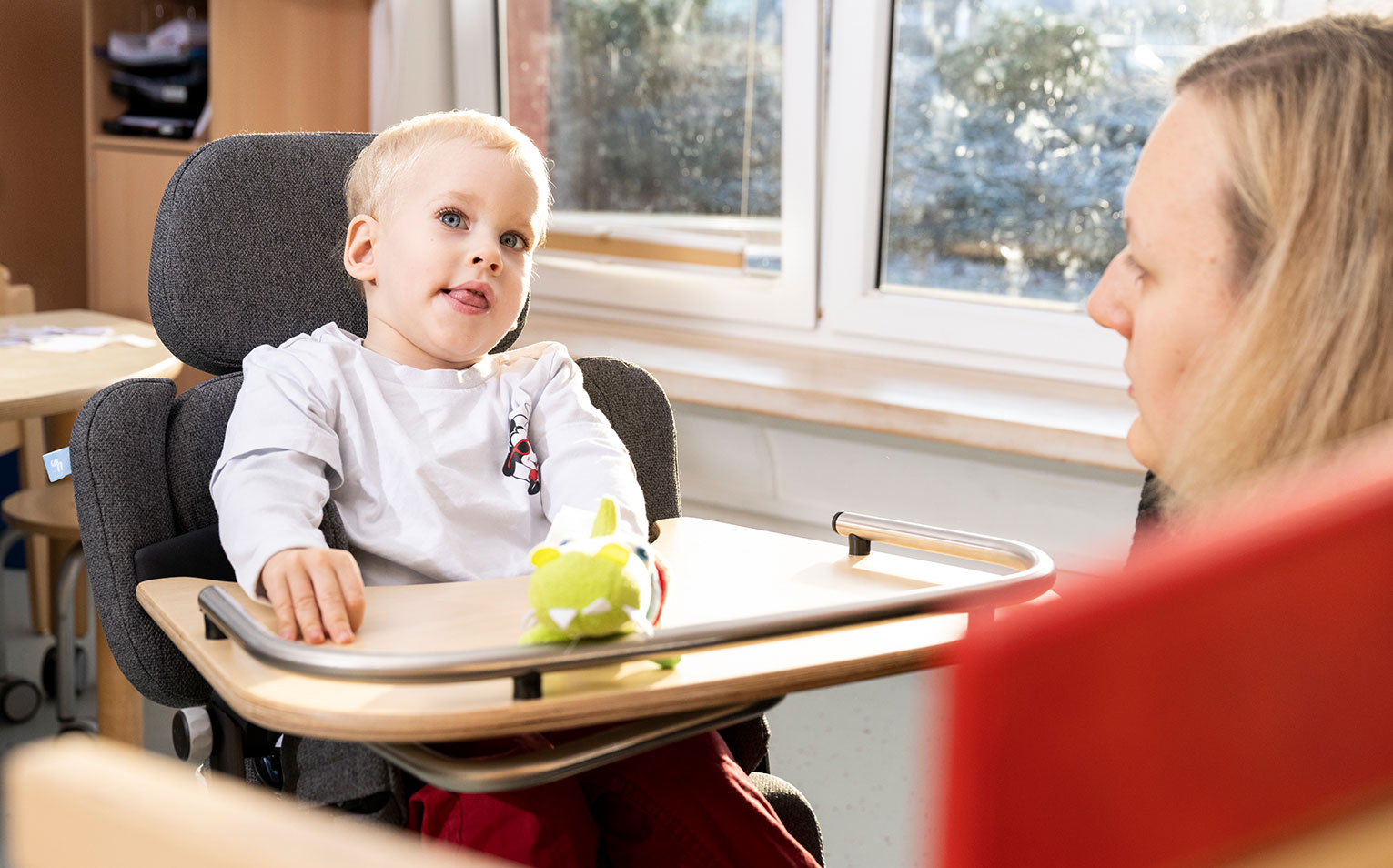
Rare Disease Day – Angelman Syndrom
Rare Disease Day on 28 February raises awareness for those affected. Ida has Angelman syndrome, a rare genetic neurological disorder with an estimated prevalence of 1 in 10,000 to 1 in 20,000 live births.
We took Rare Disease Day as an opportunity to talk to Ida’s mum Stefanie in detail. February is not only dedicated to rare diseases. It is also the time for the Blue Angels Challenge, a campaign to raise awareness of Angelman syndrome among the general public.
How did you find out that Ida has Angelman syndrome and how does the syndrome manifest itself in your daughter?
I sensed that something was wrong right after she was born. At the time, she was born after a completely normal pregnancy and birth and could not be breastfed. Extreme sucking problems are characteristic of Angelman syndrome. She also seemed to be quickly overwhelmed by many stimuli. At first, visits were therefore very limited and could only be short. Ida cried a lot. Seven to eight hours a day for several months.
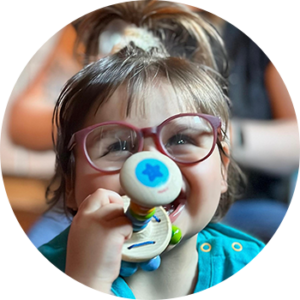
What was very difficult for me as a mother, apart from not being able to breastfeed my baby in the usual way, was that Ida reacted defensively to any kind of touch, especially on her head. Over time, and with the help of osteopathy, things improved, but from the beginning she had very high muscle tone and seemed to be constantly tense. She also stuck out her tongue very frequently during her first year of life. Overall, she seemed to develop more slowly at first, but we weren’t really worried at that point. After all, every child develops at their own pace. Ida turned over and started using her hands quite late for her age. At around 6 months, her development came to a standstill; nothing was happening and I was becoming increasingly desperate.
She absolutely refused to lie on her stomach and protested loudly.
I looked into all the possible ways to help her, tried crafts, encouraged her, motivated her, trained her… but nothing helped. At her 5-month check-up, the paediatrician finally took notice. Reassuring us that she would grow out of it was no longer appropriate. Instead, she prescribed physiotherapy for Ida. Since then, we have been undergoing weekly treatment based on the Vojta concept., but even that did not bring about the necessary developmental progress. Other mothers proudly reported on their babies’ milestones.
I, on the other hand, was caught between self-doubt, ignorance and fear.
So I distanced myself from all the social groups that mothers normally attend during this wonderful first period. I had other things on my mind! My child reacted very differently, and I couldn’t really talk to any of the other mums. From around the time of the aforementioned U5 check-up, when we were also prescribed physiotherapy, it became apparent that Ida was not only lagging behind in terms of motor skills. Her head circumference was also not increasing as it normally would. This is called microcephaly. I deliberately refrained from googling what exactly that meant. At the time, I naively thought that children’s heads simply vary in size. After the next examinations and a lack of developmental progress, the paediatrician’s face became increasingly serious. At that point, I began to research the condition more thoroughly. In MSD Manuals, I found the following description, which literally knocked me off my feet:
“Symptoms vary depending on how severely the brain is damaged or underdeveloped: Some of the problems that children with severe microcephaly may have include seizures, developmental delays, feeding problems, hearing or vision problems, problems with movement or balance, hyperactivity, and intellectual disabilities.”
It was now official: my child is mentally disabled.
There was nothing I could do about it. From now on, our path would be different. Our dreams and ideas about the future – shattered like soap bubbles. Shock, powerlessness, grief, deepest despair. All of this from one moment to the next. And still the question: What is wrong with her? How severe is her disability? From that moment on, we entered the long whirlpool of diagnostics. First, standard blood tests for possible metabolic disorders, MRI, EEG, special eye examinations and finally human genetic testing at the local university hospital. The whole process took six months, from the blood sample to the results. Six months that were pure torture and hell for us. It always happens to other people, doesn’t it?!
Then came the result: Angelman syndrome, caused by a small missing piece on the 15th chromosome.
From that moment on, we were parents of a severely disabled child. Care level 4, degree of disability 100%. From one moment to the next, we had to become experts, not only on this rare genetic defect, but also on the correspondence, applications, appeals and legal basis that now had to be dealt with. What were we entitled to? What would happen next?
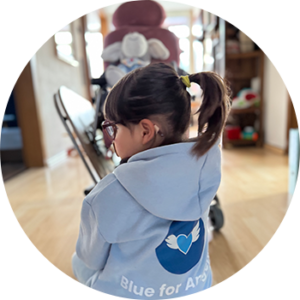
Not only did we have to learn to understand our new reality and radically accept that nothing could be done to change it, we also had to deal with the fact that those around us were initially completely taken aback and themselves unsure of how to deal with it.
Grief needs space and, above all, time.
It is not a linear growth curve, but rather there are phases in which one can better accept the new life, and then there are also phases of deep despair, anger, and hopelessness. This is still the case today. Immediately after the diagnosis, we decided to network with like-minded people to share our fears and concerns. We immediately joined the Angelman.e.V. association and were warmly welcomed into this community. Every question is allowed, and so we also joined the bubble of caring parents on social media. Here we meet families who can understand us completely. There are no stupid questions here; here you are understood without words and, above all, supported. For the very first time, we felt truly understood because other families had gone through similar experiences. We are still grateful for that today.
Ida has significant developmental delays in all areas.
The gap between her and her peers is getting bigger and bigger. She will soon be 3 and still cannot walk freely. She currently pulls herself up on objects and can walk a few steps with support. This is a huge improvement compared to her first year of life. She will remain non-verbal and will have to learn to express her needs and desires in other ways. To this end, we have now started using assisted communication. We hope that one day she will be able to communicate with us.
She vocalises, but understands much more than she can express herself.
Her lively and friendly nature makes it easy for her to connect with other people. People with Angelman syndrome laugh a lot and tend to be cheerful by nature. They love water and anything that crackles and glows. They often develop epilepsy later in life. Ida shows neurological abnormalities but does not yet require anti-epileptic medication. Angelman syndrome is also characterised by motor difficulties, such as a wobbly, wide-legged gait and ataxia. This makes it difficult for Ida to maintain her balance.
Fine motor skills are difficult for her due to her tremors and poor coordination.
She also has underdeveloped perception. She needs strong, clear stimuli in order to feel and classify them properly. She is also very sensitive to temperature and reacts defensively to heat. She has no awareness of danger, which is unlikely to develop. She therefore requires round-the-clock care and supervision. A very troublesome symptom, which has also been present in Ida since infancy, is difficulty falling asleep and staying asleep, which is very typical of the syndrome. It is not uncommon for her to be awake for hours at a time, lasting for weeks and months. People with Angelman syndrome do not exceed the mental age of a three-year-old child and therefore require intensive care throughout their lives.
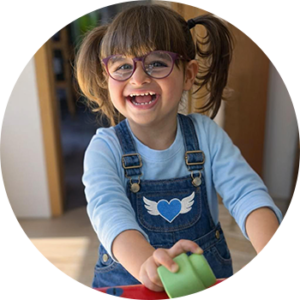
What sets Ida apart, despite her many impairments, is her positive and heart-warming nature.
She ALWAYS manages to bring a smile to the faces of those around her. Our daughter is a very friendly, curious and, in her own way, communicative little girl who is slowly discovering the world for herself. She is content with so little and is easily excited. Ida is so authentically real, so wonderful! She is our sunshine. And we will always fight for her, stand up for her and give her a voice.
What aids do you use in everyday life and what has changed/improved for you as a result?
Due to the lack of tension in her mouth, she is still unable to suck and therefore cannot drink from a standard cup. She still needs a special dysphagia cup with a small opening. Chewing was also difficult for her for a long time. Due to her lack of mouth and chewing coordination, she often choked. With the help of speech therapy desensitisation exercises, she can now chew well, but tends to stuff her mouth. Therefore, we have to offer her food in small pieces, otherwise she would quickly choke. Many people with this condition squint. Ida does not, but she is long-sighted and has astigmatism and has worn glasses since her first birthday.
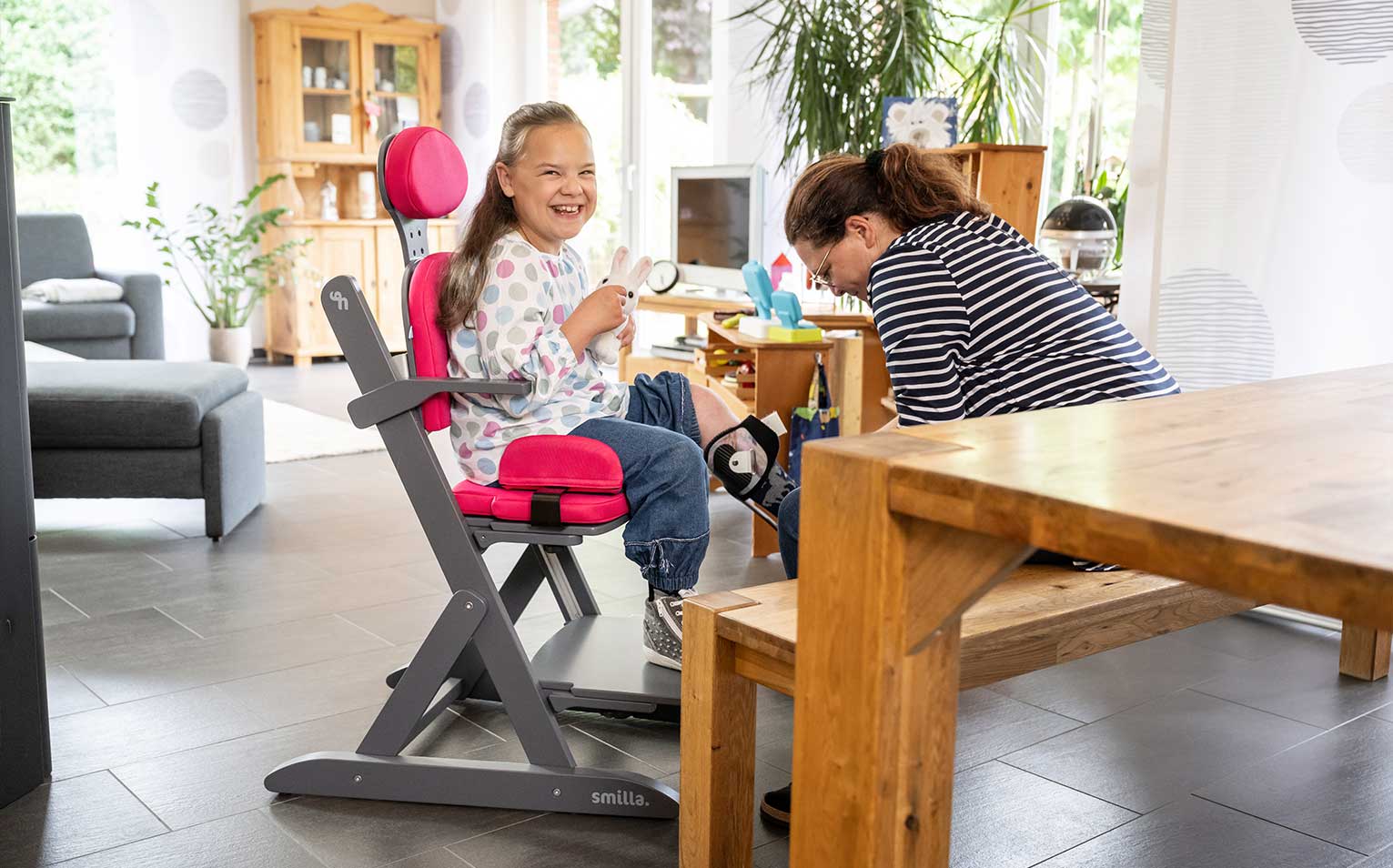
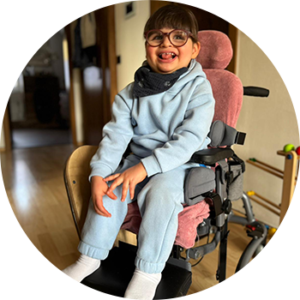
Our first aid device was the madita-fun. therapy chair and a rehab buggy.
Especially in the beginning, the pads provided her with good, adequate support so she could sit without tipping over. This enabled her to maintain a healthy posture, even for long periods of time. The therapy chair can also be lowered to almost floor level, which was very practical as it allowed her to communicate with other children at eye level while sitting passively. We also use the therapy chair frequently at home, for example when we brush her teeth. Thanks to her own table, she can eat her meals right next to us. The therapy chair was indispensable during rehabilitation, as she would not have been able to sit comfortably in the local high chairs.
Last but not least, we have a therapy couch on which we can conveniently perform the daily Vojta exercises on the kitchen table. This provides Ida with a comfortable place to lie down and me with a good working height, as we selected the appropriate height in advance. The couch can be folded up very conveniently and serves as a climbing platform in the living room outside of exercise times.
If you could wish for anything in relation to Ida’s syndrome and your everyday life, what would it be?
I would like to see research into Angelman syndrome progress. There are already clear improvements in many areas. But it will take time and, above all, financial support before a real treatment can be developed. In addition to symptomatic improvement through future therapies, I wish for Ida above all a society in which she is welcome just as she is. A society in which she meets people who understand and want to support her.
What advice would you give to other parents affected by this condition?
Don’t forget yourselves in your stressful and exhausting everyday life! As caring parents, you must be your top priority. Without you, things won’t run smoothly. If you are not well, your children cannot be well either. Delegate responsibilities where possible and do something good for yourselves in your free time. You do so much! Not because you are so strong, but because you have to be. You did not choose this everyday life, but you can choose what you want to do for yourselves – so that you can keep going.
We would like to express our sincere thanks to Ida’s mum Stefanie for her emotional answers and for the deep insight she has given us. We wish you all the best!